Basile Peak: the mountain of Equatorial Guinea

Basile Peak: the mountain of Equatorial Guinea

Equatorial Guinea is known for being one of the richest countries in terms of natural biodiversity. In Africa, our country is a conservation sanctuary that has become crucial for preserving a wide variety of flora and fauna species.

One of the reserves playing a significant role in these efforts is Basile Peak National Park. Here, we will tell you everything you need to know about this natural area in Equatorial Guinea.

Location and extent of Basile Peak

The Basile Peak Nature Reserve is located on the island of Bioko, near the country’s capital, Malabo, and comprises the highest mountain in all of Equatorial Guinea, Basile Peak. This mountain reaches a height of 3011 meters above sea level.

With an area of 300 square kilometers, Basile Peak Park, formerly called Pico de Santa Isabel, allows visitors to enjoy one of the three extinct volcanoes that make up the island. The distance between this reserve and the most populated city and capital of the country is only 41 kilometers—less than 1 hour away!

What is the geography of Basile Peak like?

Formed from volcanic activity, Basile Peak features a rugged and varied geography typical of volcanoes. A perfect example is not only Basile Peak, the highest, but also other peaks such as Loros, Monteverde, Agujas, Rampa, Sitial, and Pirámide.

There are also small open calderas like the Bonyoma caldera. Even in the remnants of old volcanoes, lakes such as Lake Loreto and Lake Esaá have formed. Additionally, the island’s geography is marked by a coastline with black sand beaches.

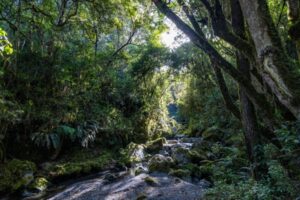
Thanks to Basile Peak’s rugged formation and the abundant rainfall in its rainforests, numerous rivers emerge. For example, we can find the Ría-Ría, Cope, Bao, Uba, Date, Buye, and Apu rivers, all flowing into the coast.

The climate of Basile Peak

Regarding the climate of Basile Peak National Park, it is of the equatorial tropical type. This climate is characterized by a marked thermal regularity with temperatures ranging from 24 to 27 degrees Celsius, depending on the season.

However, it’s worth noting that in higher areas such as the summit of the peak, temperatures can be much lower and colder due to the altitude. Similarly, the climate of Basile Peak differs from that of the continental region, as it is located on an island.

In terms of precipitation, Basile Peak has two rainy seasons, from March to June and from September to November. The intensity of rainfall is usually abundant, which ensures that the water basin remains consistently filled.

The flora of Basile Peak

According to the Guineo-Congolian rainforest domain (White, 1983), the flora of Basile Peak is primarily characterized by humid and tropical forests up to about 3000 meters above sea level, beyond which subalpine flora is found.

While the island was originally covered in rainforests, cacao cultivation has now been limited to some patches. Notable species found here include Ilomba (Pycnanthus angolensis), bokapi (Staudia gabonensis), and Sarcocephalus esculentus, as well as various ficuses. Additionally, a new species, the palomero (Musanga cicropioides), has been introduced through human intervention.

In the mountain region, both mosses and lichens are present, as well as smaller and more compact trees. On the grasslands, ericaceous plants such as Aguaria salicifolia, Philipia mannii, and Hypericum lanceolatum can be found.

Carretera a Basile

What is the fauna like in Basile Peak?

Regarding the fauna, Basile Peak is notable for the presence of small mammals such as antelopes. Monkeys like the Preuss’s monkey and the red-eared monkey can also be found. Other species inhabiting the Basile Peak ecological reserve include the black colobus and the drill.

However, the most remarkable animal is the Zosterops brunneus, also known as the Fernando Po white-eye, which is an endemic bird species not only to Equatorial Guinea but also to Bioko Island. In fact, this species is one of the most attractive for birdwatching enthusiasts.

Human activity in Basile Peak National Park

Currently, there are no human settlements within the Basile Peak reserve, although it has been impacted by activities such as agriculture and cocoa plantations. Various paths and a TV installation on the peak itself can also be found.

Beyond these human traces, Basile Peak National Park remains remote from human presence. There are laws in place to prevent its exploitation for purposes such as agriculture or the timber industry.

Conservation status of Basile Peak

Although Basile Peak has significant natural wealth, no major conservation and protection projects have been implemented. Besides existing laws such as Law No. 8/1988, dated December 31, which protects this natural reserve and condemns hunting, there are no further projects.

At present, we can say that Basile Peak National Park is not under immediate threat, but its condition does require attention. This is especially important to mitigate risks from poaching and illegal logging, as well as the effects of climate change.

Road to Basile

Tourism within Basile Peak

Thanks to its proximity to the capital Malabo, Basile Peak is perfectly suited for ecotourism. Activities such as hiking, birdwatching, wildlife observation, and climbing in its calderas are popular here.

Additionally, its closeness to the coast allows access to incredible, nature-filled, and tranquil beaches. Agencies like Rumbo Malabo offer specialized tours to explore this natural gem of Bioko Island.

Picture of Rumbo Malabo

Rumbo Malabo

Tour Operator in Equatorial Guinea

¿Te ha gustado? Compártelo con tus amigos en cualquier red social y ayúdanos a crecer.

Facebook
Twitter
LinkedIn
Email
WhatsApp
Telegram

Birdwatching Guide for Travelers in Equatorial Guinea

Did you know that Equatorial Guinea is one of the best birdwatching destinations in West Africa? If you’re passionate about nature, photography, or simply looking for a different kind of trip, get ready to look up and fall in love with a sky full of life and color. With over 300 bird species, many of them endemic or hard to find elsewhere in the world, this small country is a gem for birdwatching tourism enthusiasts.
From the misty peaks of Pico Basile to the jungles of Monte Alén and the calm banks of coastal rivers, every corner offers a natural concert of songs, acrobatic flights, and stunning colors.
Read More
Annobonese People

History, Culture and Tradition on Annobon

Annobon, a remote and fascinating island of Equatorial Guinea, boasts a rich history, vibrant culture, and deep-rooted traditions. Influenced by its Portuguese and African heritage, the island’s unique Creole identity is reflected in its language, music, and customs. From traditional dances to community-driven fishing practices, Annobon offers a glimpse into a way of life shaped by resilience and a strong sense of unity.
Read More
``
Rumbo Malabo
Privacy Overview

This website uses cookies so that we can provide you with the best user experience possible. Cookie information is stored in your browser and performs functions such as recognising you when you return to our website and helping our team to understand which sections of the website you find most interesting and useful.